CLICK ON THE LINK TO MAIL EXCHANGE
desk@pennysharefortune.com
WILL THIS BULL BE THAMED??
http://money.cnn.com/video/news/2011/01/17/n_bz_stocks_soaring.cnnmoney/


According to the Stock Trader's Almanac, November is the beginning of the stock market's strongest six-month period. The "Best Six Months Switching Strategy" goes like this: Invest in the Dow and/or S&P 500 between November 1 and April 30 each year, then switch into safer fixed income assets in May.
"We found that most of the market's gains are made from November to April, whereas you either go down or are flat from May through October; hence the sell in May and go away [strategy]," says Jeff Hirsch, editor-in-chief of the Stock Trader's Almanac.
Historically, there's a soft period from May through October, as seen in STA's chart below.
"We like to buy in October and get ourselves sober, even though we didn't get our trigger this year because the market was vacillating quite a bit," says Hirsch. He uses a MACD indicator as a trigger for buy and sell moves. Using the MACD, the DJIA's Best Six Months rises to an average gain of 9.3% versus a loss of 1.2% during the Worst Six Months.
On average as seen in the chart below, the Dow Jones Industrial Average has risen 7.5% during the Best Six Month period since 1950, versus 0.3% rise during the Worst 6 Months.
"Last year everyone was bearish — I was one of the lone bulls on the Street. I was really happy with our buy signal," says Hirsch. "This year I'm not so confident because the market technically is struggling against resistance; there are a lot of issues, there's a post-election year coming up, there's fiscal cliffs. So we're going in with tighter stops with our trades this year."
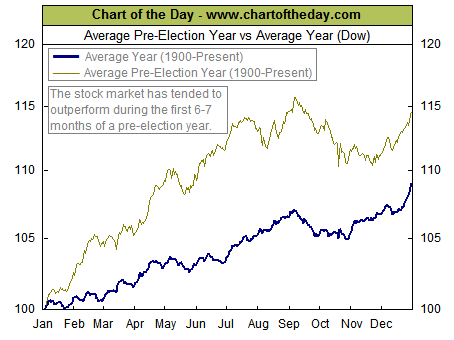
Needless to say, November is off to a very weak start with the DJIA, S&P 500 and Nasdaq all down over 4% month-to-date. Hirsch has already warned of risk in 2013 based on the election cycle and historical weakness when an incumbent president is re-elected.
"Again, we're at the sour spot of the four-year [presidential election] cycle," he admits. "We'll make our trades, but we'll be a lot more cautious and keep the stops a lot tighter instead of leaving it wide open here."
If this is as good as it gets, maybe that's a sound warning for the year ahead. How are you positioning for 2013? Let us know in the comment section below or visit us on Facebook!
More From Breakout:

 go the dragon


 VIX reverse sharpely





 the wisdom of the Liberal abuse by
 the scams of Labors..



| Chart of the Day |  |
| Why China Risks Repeating an American Disaster Monday, 27th June 2011 Melbourne, Australia By Kris Sayce
.............................................................................................................................................................................
............................................................................................................................................................................. In today’s Money Morning: Low debt and high savings... Australia in the wrong corner... Production to consumerism - and the risks involved... Uranium, gas or something else... Why China Risks Repeating an American Disaster "The strength of the real-estate market directly affects the construction, steel, concrete, power and appliance industries. In all, about 50% of China’s GDP is linked to the fate of its real-estate market, according to Standard Chartered economist Stephen Green." - Wall Street Journal The debt problems in Greece are nothing compared to the China Problem. At first glance the numbers suggest China is in top shape. Take this chart we found: Low debt, high savings  Source: Seeking Alpha And for savings rates, you want to be towards the top... again, where China is (although Singapore is in the best position at top right). And the spot to avoid is the bottom part of the chart... again where the U.S. and U.K. are. And where Australia is headed. But here’s the problem... China only has low debt levels because Western economies have high debt levels. And China only has a high savings rate because Western economies have a low savings rate. Which is fine... for a while. But when your customers run out of credit and can no longer spend, what does a business do? How to become a consumer nation The argument in the mainstream is that China will just start buying its own stuff. It will become a consumer nation.But how will it do that? At the end of 2010, China had the equivalent of USD$2.85 trillion in foreign reserves. Of that, USD$1.16 trillion was invested in U.S. government bonds. In other words about 40% of China’s wealth is held in U.S. dollar denominated debt. The problem for China is if it wants to become a consumer nation, it needs to get rid of those U.S. dollars. And that’s China’s biggest problem. First up, selling U.S. dollars will devalue those it still holds. It’d mean China getting less Yuan for their dollars than they’d hoped. And that means less cash for consumers. The idea that becoming a consumer nation is the solution is ridiculous. As with most poorly thought out solutions, it only appears to work in the short term. Think back to what we said earlier. If a major customer stops spending, what will that do for a bus iness? That’s right, it spells trouble. Even if previous spending had built a big cash reserve. So unless the business can find new customers it will need to use savings. According to the mainstream, that’s just what China needs - start spending everything it has saved. But think about that in a business perspective again. Would it really make sense for a company to blow the budget on expenses at the same time as it lost its main customer? Of course not. Not if the company wants to remain viable in the long run. What it really needs is to find more customers. Why China will face the same problems as the U.S. For instance, think how consumption policy has worked in the past. It’s exactly what the U.S. started doing 50 years ago. It started buying everything it produced... and then more... using credit.Even being the world’s largest manufacturer wasn’t enough to save it, be cause it consumed more than it exported. But that’s exac tly the policy China is set to follow. And it’s being cheered on by the West. Having run out of customers, instead of cutting back on production, the central planners and Westerners think the best idea is to have China spend its savings. As you can see from the charts above, there’s plenty to spend. But when you combine falling exports with higher spending, it won’t take long for China’s position to reverse. What will that mean for Australia? Funnily enough, it could mean Australia’s status as the "Lucky Country" gets one more stroke of luck. It could mean China’s demand for resources continues as it becomes a consumer rather than an exporter nation. But don’t jump for joy yet. Even if the Chinese consumer fills the gap left by Western consumers, the transition won’t be smooth. Yes, China may keep the Australian economy afloat a while longer, but you shouldn’t fall fo r the mainstream spin that it’ll be painless. Cheers. Kris Sayce Money Morning Australia A Threat? Or an Opportunity? By Aaron Tyrrell, Editor, Money Morning Nine out of 10 households have been promised tax cuts, pension increases and a boost in family payments to help cope with the increased cost of living under the carbon tax. Nine out of 10 households?! That means somewhere around eight million taxpayer-funded bribes will be handed out... to Aussies with a household income of less than $150,000... to cover the cost of the new tax... No wonder poll results in the Sydney Morning Herald reveal the carbon tax is more hated than ever. Now you should take poll results with a fistful of salt. But it doesn’t matter. The carbon tax WILL come in, in some form, no matter who has the powe r. So it’s time to stop griping and start looking for opportunities. According to Diggers & Drillers editor, Dr Alex Cowie, uranium stocks could be back on the up as we move into the second half of this year. Why? Well, all the fuss about these carbon belchers could leave the door ajar for uranium to trumpet its case as the clean, green and reliable alternative to dirty coal. (You can read what Alex had to say in full in the Daily Reckoning here.) Although it may take a while to shake off the Fukushima blues. If you want an example of how uranium stocks have fared since the Japan crisis, the following three stocks have dropped an average 45.53%: PepinNini Minerals Ltd (ASX:PNN), U3O8 Ltd (ASX:UT O) and Thundelarra Exploration Ltd (ASX:THX). Are any of them any good? We don’t know. But they’re cheap. The priciest will set you back less than 30 cents a share. Although Australian Wealth Gameplan editor, Dan Denning would argue there’s good reason for that. In an advanced note to the special report he’s due to release, Dan said the Age of Oil will give way to the Golden Age of Gas. That seems to make sense. Gas is proven and compared to nuclear energy, low cost. Or maybe you should forget energy and start looking for other opportunities. Money Morning reader, Geoff W. wrote in last week to point out property developers could be set to double their money at a carbon price of just $10 a tonne. I’m still looking into this story - it seems to be buried under piles of clauses, bullet points and addendums in pa rliamentary papers - and will let you know what I find... More to come... but it wouldn’t be the first time property developers have come up with an excuse for why property must double! Aaron Tyrrell Editor, Money Morning PS. Dan’s special report on oil, natural gas and the Middle East is due any day. Keep an eye on your inbox over the next few days. In our view it could be the most important piece of research you read this year... Related Articles Why You Shouldn't Buy China Which Commodity is Set to Take Off Next? Is It Time to Buy This Unloved Energy Play? The Petro Dollar Standard in Crisis Why I'm Flying the Flag for China From the Archives... Why This is a New Golden Age for Energy Stocks 2011-06-24 - Kris Sayce The RBA Strums While the Australian Economy Burns 2011-06-23 - Kris Sayce Beware the Sub-Prime Food Market 2011-06-22 - Kris Sayce Is OPEC Following Michael Corleone's Advice?< /strong> 2011-06-21 - Kris Sayce The Depression You Better Hope We Have 2011-06-20 - Kris Sayce For editorial enquiries and feedback, email moneymorning@moneymorning.com.au |  | .......................................................
....................................................... ....................................................... "Multiple chances to spin grubstakes into 'dream hauls' in the time it takes to need a new haircut..." Slips tream Trader Murray Dawes is going to deliver a whole new calibr e of short-term, higher-risk, greater-return trades on TOP of his regular trades. You should only trade these alerts if you have a very high risk tolerance. To learn more about how Murray is going for triple-digit gains inside three months, watch this video presentation. ....................................................... ....................................................... The secret deal that rig ged global silver prices - and one Aussie stock set to benefit... How a silver price manipulation scandal, a hit-and-run accident and a courageous whistleblower have handed you the chance to capitalise on the silver boom - before prices surge again in 2011. For full details click here. ....................................................... |
Returns on Australian compulsory superannuation savings, a scheme sold to workers as a substitute for the old-age pension, have barely surpassed the rate of inflation over the last 14 years, according to official figures compiled by the government-funded Australian Broadcasting Corporation (ABC). These figures are proof that the superannuation system, which Labor and the trade unions proclaim as their “proudest achievement”, is one of the greatest swindles in Australian history.
According to the ABC’s compilation of figures released annually by the Australian Prudential Regulation Authority, the average annual return on superannuation investments between 1997 and 2009 was just 3 percent, as compared to an inflation rate across the same period of 2.8 percent. Taken over past decade, superannuation funds have returned less than the inflation rate—meaning that workers would have been better off simply putting their money in the bank.
The figures are partly explained by market volatility, especially the huge losses during the initial stages of the global financial crisis, and by poor investment decisions on the part of superannuation funds managers. Just as importantly though, the risible returns are all that is left over once investment advisors and fund managers, including trade union bureaucrats, take their hefty slice. A staggering $A17 billion in fees—or $48 million per day—is siphoned off each year from workers’ savings. As the ABC pointed out, this sum alone would be sufficient to fund the entire Australian old age pension system. Yet none of the major parties—Labor, Liberal or the Greens—has commented on these extraordinary figures during the current election campaign, much less on the question of old age incomes more generally.
Compulsory superannuation, introduced by the Keating Labor government in 1992, involved an obligatory employer contribution of 3 percent of each worker’s wage to superannuation funds, which would then be invested in Australian securities, especially the stock market. The chief aim was to transfer a large pool of capital into Australian investment banks, which would then be in a position to punch above their weight on the global stage. In other words, there is a direct link between Labor’s super system, the refusal of successive governments to increase the poverty-level old-age pension and the increasing financialisation of the Australian economy.
The trade unions were involved from the outset. The scheme was a key plank of the “Accord” reached by trade unions and the Labor government to suppress real wages, boost “international competitiveness” and end worker militancy. Union leaders are now involved in the management of superannuation funds worth billions of dollars and thus have a direct stake in ensuring the ongoing implementation of pro-market policies to boost the financial markets.
By 1996 the employer contribution rate had risen to 9 percent. However, with the assistance and support of the unions, this levy was compensated by the abolition or reduction of wage increases. In other words, the compulsory employer contributions were, in effect, paid by the workers themselves.
By 2010, the Australian superannuation pool had risen to $1.17 trillion, making Australia the largest per capita holder of superannuation funds in the world and the fourth largest in gross terms. The figure is equivalent to 100 percent of GDP. Superannuation funds own 26 percent of shares on the Australian stock exchange. As part of Labor’s original deal with the unions, about a quarter of the superannuation pool is controlled by the unions in so-called “industry” superfunds.
In this year’s budget, handed down in May, Labor promised the unions and the finance industry that it would increase compulsory superannuation contributions from 9 to 12 percent of wages by 2019. In line with the current model, then Prime Minister Kevin Rudd invited employers, at the time of the budget, to take the new super impost “into account when negotiating future wage agreements”. According to Labor’s estimates, a further 3 percent increase in super contributions will add $85 billion to Australia’s superannuation pool in the next decade, and more than $500 billion by 2037. The stakes for Australian capitalism in maintaining and expanding the current superannuation system are therefore huge. Finance sector research company Rice Warner estimates that within 15 years, total superannuation holdings will have increased to $A2.7 trillion.
According to Jeff Breshnahan, head of superannuation research firm SuperRatings, the bulk of the $17 billion from compulsory super investments—about $9 billion—goes to well-paid investment managers, whose salaries are, even by finance industry standards, “incredibly high”. As Mike Rafferty, a researcher at the University of Sydney points out, “average wage and salary earners…are subsidising massive salaries that go to fund managers.”
Moreover, fund managers receive these huge salaries regardless of whether their investment decisions increase or reduce workers savings over the course of a given year. Their pay is calculated not on return rates, but on the size of funds under management. Because 9 percent of workers’ wages will roll into the share market regardless of market performance, management salaries are guaranteed. Further, as the ABC pointed out, the vast bulk of the $1.17 trillion super pool is made up of contributions, not of returns on investments. Contributions have been boosted by a series of tax concessions engineered to make superannuation a superficially attractive investment for higher income workers. Prior to the eruption of the global financial crisis in 2007-08, tax incentives introduced by the Howard Coalition government caused a sudden exodus of household assets into super funds. Some $381 billion, about a third of the total $1.17 trillion super pool, was added in the years 2005 to 2007.
The most powerful indictment of the compulsory superannuation system is abundant proof that most workers will still be dependent on the poverty-level pension in their retirement. In other words, despite contributing 9 percent of their wages to Australian superannuation funds, and thus the stock market, every week for the past 15 years, most Australians still have superannuation accounts of less than $70,000. As former Prime Minister Kevin Rudd admitted earlier this year, “a low-income earner on half of average weekly ordinary time earnings [that is, on $31,000 per year] would expect to be 80 percent reliant on the age pension after retirement.”
The solution put forward by the superannuation industry, government and the unions is not to increase the aged pension—which has continued to fall in real terms over the last 20 years—but to increase the retirement age for eligibility for the pension. Under plans unveiled by Labor in the 2009 budget, the Australian government will increase the pension age from 65 to 67 in 2019 —the first increase in the male retirement age since aged pensions were introduced in 1909. Given business demands for budget austerity, the proposed change could well be brought forward. Treasurer Wayne Swan said earlier this year that unless the pension age was increased substantially, society could not afford to look after its elderly: “The blue-collar workforce is impacted upon by the stress on their bodies over time, I openly acknowledge that. But what we have to do is go back to basics here… if we don’t make these changes, the system may not be viable.” Given that the amount siphoned off in superannuation fees could pay for pensions, the statement is a complete lie. Swan’s comments underscore the degree to which he, the Labor government and the whole political establishment is in the thrall of big business—more specifically, of the powerful finance sector—that participated enthusiastically in the worldwide speculative orgy that precipitated the current global economic crisis.
Click here for full coverage of the SEP 2010 election campaign
Authorised by N. Beams, 307 Macquarie St, Liverpool, NSW 2170


Disclosure statements:
all contents of this blog are a selection of informations from the domaine and has to be treated
as amusements purpose, with no liabilities whatsoever
Max Gunther set forth basic trading principles called The Zurich Axioms:
On Risk:
- Worry is not a sickness but a sign of health - if you are not worried, you are not risking enough.
- Always play for meaningful stakes - if an amount is so small that its loss won’t make any significant difference, then it isn’t likely to bring any significant gains either.
- Resist the allure of diversification.
On Greed:
- Always take your profit too soon.
- Decide in advance what gain you want from a venture, and when you get it, get out.
On Hope:
- When the ship starts sinking, don’t pray. Jump.
- Accept small losses cheerfully as a fact of life. Expect to experience several while awaiting a large gain.
On Forecasts:
- Human behaviour cannot be predicted. Distrust anyone who claims to know the future, however dimly.
On Patterns:
- Chaos is not dangerous until it starts to look orderly.
- Beware the historian’s trap - it is based on the age-old but entirely unwarranted belief that the orderly repetition of history allows for accurate forecasting in certain situations.
- Beware the chartist’s illusion - it is characteristic of human minds to perceive links of cause and effect where none exist.
- Beware the gambler’s fallacy - there’s no such thing as "Today’s my lucky day" or "I’m hot tonight".
On Mobility:
- Avoid putting down roots. They impede motion.
- Do not become trapped in a souring venture because of sentiments like loyalty and nostalgia.
- Never hesitate to abandon a venture if something more attractive comes into view.
On Intuition:
- A hunch can be trusted if it can be explained.
- Never confuse a hunch with a hope.
On the Occult:
- If astrology worked, all astrologers would be rich.
- A superstition need not be exorcised. It can be enjoyed, provided it is kept in its place.
On Optimism & Pessimism:
- Optimism means expecting the best, but confidence mean knowing how you will handle the worst. Never make a move if you are merely optimistic.
On Consensus:
- Disregard the majority opinion. It is probably wrong.
- Never follow speculative fads. Often, the best time to buy something is when nobody else wants it.
On Stubbornness:
- If it doesn’t pay off the first time, forget it.
- Never try to save a bad investment by "averaging down".
On Planning:
- Long-range plans engender the dangerous belief that the future is under control. It is important never to take your own long-range plans or other people’s seriously. In essence these axioms point to the benefit of having an investment strategy and sticking to it, regardless of what other investors say or do. If you don’t have an investment strategy, you could do worse than adopt these principles. However, don’t be afraid to add or subtract ones according to what works for you.
1. Sell the Losers and Let the Winners Run
2. Make Winners Win Big
3. Losers Demand Careful Strategy
4. It Is Better to Average Up Than to Average Down
5. Good Companies Buy Their Own Stock
6. Price Doubling Is Easy at Low Prices
7. Look for Insider Trading
8. Buy Low, Sell High
9. Buy High, Sell Higher
10. Buy on the Rumour, Sell on the News
11. Sell High, Buy Low
12. The Perfect Hedge Is Short against the Box
13. Never Short a Dull Market
14. Never Short the Trend
15. Never Buy a Stock Because It Has a Low Price
16. Beware the 'Penny Stock'
17. Give Stop Orders Wiggle Room
18. Buy the Stock That Splits
19. Instit unions Show Where the Action Is Now
20. Avoid Heavy Positions in Thinly Traded Stocks
21. There Are at Least Two Sides to a Story
22. Follow a Few Stocks Well
23. Be Wary of Stock Ideas from a Neighbour
24. Get Information before You Invest, Not After
25. Never Fight the Tape
26. Heavy Volume, the Price Rises - Light Volume, the Price Falls
27. Buy on Weakness, Sell on Strength
28. It Is Best to Trade 'At the Market'
29. Understand the Types of Orders
30. Order Modifications Might Cause Decay
31. Remember That Others Might Have the Same Idea
32. Use Limit Orders as Insurance
33. Vales can be Found Bottom Fishing
34. Heavily Margind, Heavily Watched
35. Winners keep on Winning
36. Indicators Can Meet Overriding Factors
37. Take a Loss Quickly
38. Beware The Triple Witching Hour
39. Buy on Monday, Sell on Friday
40. Never get Married to the Stock
41. Diversification Is the Key to Portfolio Management
42. Partial Liquidation Might Be the Answer
43. Act Quickly, Study at Leisure
44. Records Can Make Money
45. Fraud is Unpredictable